
Best Crypto To Buy Under $1: Top Coins With Solid Potential

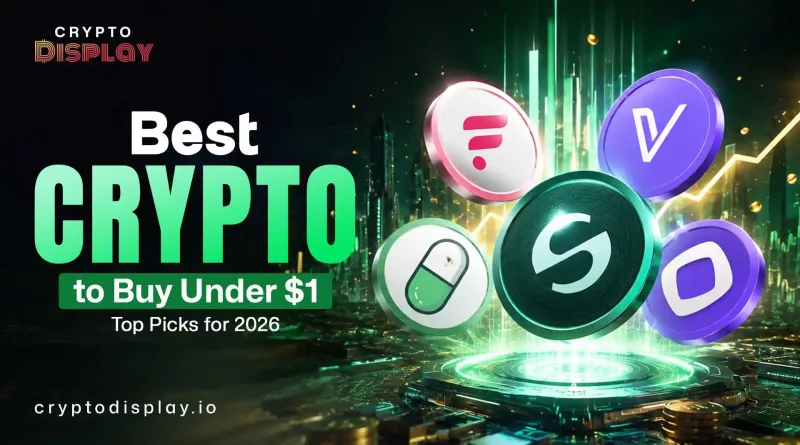
Best Crypto to Buy Under $1: Top Tokens With Real Utility in 2026
A dollar still buys a lot in crypto. Some of the most active Layer 1 and utility tokens right now trade for a few cents, and that price tag is exactly why so many traders keep circling back to them. If you're hunting for the best crypto to buy under $1 to buy in 2026, the real question isn't just "which coin is cheap"; it's which cheap coin actually does something useful with its network.
Low price alone means nothing. A token can sit at $0.005 and still carry a market cap north of half a billion dollars once you multiply it by billions of coins in circulation. So instead of chasing a low sticker price, it helps to look at what each project is building, how much volume it moves daily, and where the token sits in its own supply cycle. That's the lens we're using for this list.
Why Cheap Doesn't Mean Risk-Free
A lot of newer traders assume affordable cryptocurrencies are automatically "safer" because you can buy more units. That's a myth worth killing early. Price per token has no bearing on volatility, team quality or long-term utility. A $0.006 coin can swing 20% in a day just as easily as a $50 one.
What actually separates a low priced crypto worth holding from one that's just noise is usage. Is the network processing real transactions? Is trading volume healthy relative to market cap? Are developers still shipping? Those questions matter far more than the number to the left of the decimal point.
Top Crypto to Buy Under $1 With Growth Potential
Here are five tokens currently trading under a dollar that stand out for different reasons from enterprise adoption to raw transaction speed.
1. Flare (FLR)
Flare is an EVM-compatible Layer 1 built to handle smart contracts secure, decentralized access to data from other blockchains and the wider internet. Its two core protocols, the State Connector and the Flare Time Series Oracle, let developers pull in cross-chain and real-world data without relying on a single centralized source.
- Price: $0.006455
- Market cap: $561.43 Million
- 24-hour volume: $3.55M
Flare's pitch is interoperability at the data layer, not just token bridges. That's a narrower niche, which cuts both ways useful when oracle demand grows, quieter when it doesn't.
Investor note: FLR sits close to its all-time low set earlier this year, so anyone watching this one should track oracle adoption numbers rather than price alone before deciding on entry points.
2. VeChain (VET)
VeChain is an enterprise-focused Layer 1 built around supply-chain tracking, product authenticity and sustainability data. Its dual-token model splits VET, the staking and value asset, from VTHO, the gas token used for transaction fees, a structure meant to keep app costs steady even when VET's price moves.
- Current Price: $0.006975
- Market cap: $599.72M
- 24-hour volume: $89.29 Million
VeChain recently completed its Hayabusa upgrade, moving the network from Proof-of-Authority to Delegated Proof of Stake. That's a meaningful shift in how the chain is secured, and the jump in 24-hour volume relative to VeChain's usual range suggests renewed trading interest around it.
Risk note: VET remains far below its 2021 all-time high, and enterprise blockchain adoption cycles tend to move slowly, so patience matters more than timing here.
3. Pump.fun (PUMP)
Pump.fun is the token behind the pump.fun token-launch platform and its swap.pump.fun trading protocol on Solana. The platform itself doesn't require PUMP to function, but holders get access to promotional rewards tied to the ecosystem.
- Price: $0.004516
- Market cap: $1.79B
- 24-hour volume: $250.32M
This is the most speculative name on the list, and its daily volume reflects that a vol-to-market-cap ratio near 14% shows heavy, fast-moving trading.
Investor note: PUMP is tied directly to meme coin launch activity on Solana, so its price often mirrors broader risk appetite in that corner of the market rather than any fundamental shift at the protocol level.
4. Stable (STABLE)
Stable is a Layer 1 built specifically for payments, where gas fees are paid in USDT instead of the network's native token. STABLE itself is used for validator staking, governance and ecosystem incentives rather than transaction costs.
- Price: $0.02659
- Market cap: $686.79M
- 24-hour volume: $13.87M
Removing gas-fee volatility from the payments experience is a genuinely useful design choice for merchants and remittance use cases.
Risk note: STABLE is a newer listing with a large gap between its circulating and fully diluted valuation, meaning future token unlocks could add sell pressure regardless of network activity.
5. Monad (MON)
Monad is a high-throughput Layer 1 blockchain aiming for up to 10,000 transactions per second through parallel execution while staying fully EVM-compatible, so existing Ethereum contracts and tools work on it without changes.
- Price: $0.02626
- Market cap: $310.54M
- 24-hour volume: $38.94M
Monad raised $225 million before launch, and its technical bet of faster execution without breaking Ethereum compatibility is one of the more ambitious plays on this list.
Investor note: circulating supply is only about 10% of max supply right now, so watch token-unlock schedules closely, since they can weigh on price independent of adoption news.
Quick Comparison
|
Token |
Price |
Market Cap |
24h Volume |
Core Focus |
|
Flare (FLR) |
$0.006455 |
$561.43M |
$3.55M |
Cross-chain data oracles |
|
VeChain (VET) |
$0.006975 |
$599.72M |
$89.29M |
Supply chain & enterprise |
|
Pump.fun (PUMP) |
$0.004516 |
$1.79B |
$250.32M |
Solana launchpad token |
|
Stable (STABLE) |
$0.02659 |
$686.79M |
$13.87M |
USDT-gas payments L1 |
|
Monad (MON) |
$0.02626 |
$310.54M |
$38.94M |
High-speed parallel EVM |
Cheap Crypto Under $1 Worth Watching Going Forward
None of these five tokens move in the same direction for the same reasons. Flare and VeChain lean on infrastructure and enterprise use cases that build slowly. Pump.fun rides Solana's meme-coin cycle and can swing hard in either direction within hours. Stable and Monad are newer networks still working through early supply unlocks, so their charts will likely stay choppy until more of their total supply reaches the open market.
For anyone building a shortlist of the best cheap crypto to buy, the practical approach is to split attention between the two camps: established networks with real transaction history, and newer chains with strong technical backing but thinner track records. Treating every crypto coin with potential the same way as a lottery ticket usually leads to disappointment once the initial hype fades.
Note: Crypto prices change constantly. The prices, market caps, and volumes mentioned here were recorded on August 29 and may have shifted by the time you're reading this.
Disclaimer: Best Crypto to Buy Under $1 coins is for informational purposes only and does not constitute financial advice. Cryptocurrency markets are highly volatile, and prices can change significantly within short periods. Always do your own research and consult a qualified financial advisor before making investment decisions.



Frequently Asked Questions
 Explore Our FAQs
Find quick answers to commonly asked questions and understand how things work around here.