
Best Crypto to Buy Under $1: 5 Coins Worth a Closer Look

Best Crypto to Buy Under $1: Which Coin Matches Your Risk Level Today?
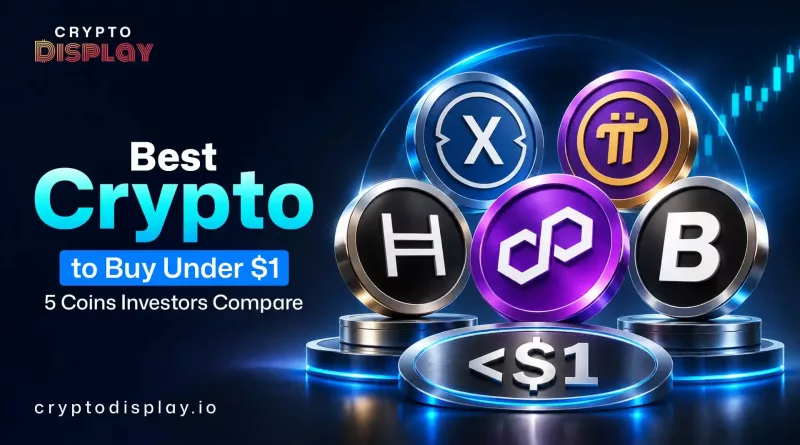
Cheap coins grab attention fast, but a low price tag says very little about value. Picking the best crypto to buy under $1 starts with market cap, daily volume, and what the network actually does. If you are building a shortlist of crypto to buy under $1 to buy in 2026, those three checks matter more than the price itself. Here are five names people keep asking about: BitTorrent, Polygon, Hedera, Pi, and XDC Network.
Key Takeaways
- Many affordable cryptocurrencies look cheap only because their supply is huge, so check market cap first.
- These five coins range from $347.86 million to $3.07B in market cap, and each does a different job.
- Volume tells you how easy it is to exit. Pi trades $2.67 million a day against an $865.12M cap, while Polygon trades $66.43M.
1. BitTorrent (BTT): A Famous File-Sharing Name With a Tiny Unit Price
BitTorrent is a peer-to-peer file-sharing network that started in 2001. TRON bought it in July 2018, and the BTT token launched in February 2019 on TRON’s TRC-10 standard. The token powers BitTorrent Speed, where users pay others for faster downloads. That gives BTT a real job inside a product many people already know. The unit price is very small because 965.41T BTT circulate, so a tiny move in cents shows up as a big percentage.
- Price: $0.0000003603
- Market cap: $347.86M
- 24h volume: $23.64M
Features: Used inside BitTorrent Speed and linked to the DePIN and distributed computing themes.
Investor note: Price still sits about 88% below its January 2022 high, and the large supply means per-coin price tells you little.
Source: CoinMarketCap Data
2. Polygon (POL): The Token That Replaced MATIC
POL took over from MATIC, and the migration happened on September 4, 2024. It is the gas token for Polygon PoS, a proof-of-stake network built to scale Ethereum, and it secures the chain through staking. Stakers earn rewards and can qualify for Agglayer ecosystem airdrops. This network supports payments, tokenized assets, and decentralized finance apps. At $0.08769, it sits in low-priced crypto territory, yet it has the highest daily volume of the five.
- Price: $0.08769
- Market cap: $933.35 million
- 24h volume: $66.43 million
Features: Pays gas fees, secures the network through staking, and gives holders a say in governance.
Investor note: POL is down about 93% from its $1.29 peak in March 2024, so a recovery is never guaranteed.
3. Hedera (HBAR): A Hashgraph Network Built for Business
Hedera runs on hashgraph consensus instead of a standard blockchain. Nodes pass data to each other through a gossip method, and the network states a fee near $0.0001 with finality in under five seconds. HBAR pays for smart contracts, file storage, and token services, and it can be staked to help secure the network. A governing council of up to 39 organizations steers key decisions. That setup targets enterprises that want speed and predictable costs. HBAR is also the largest cap of the five.
- Price: $0.06937
- Market cap: $3.07B
- 24h volume: $39.12 million
Features: Token Service and Consensus Service, with a fixed maximum supply of 50B HBAR.
Investor note: Governance sits with a council, which some investors see as less open. HBAR also fell 9.16% over seven days in this snapshot.
4. Pi (PI): A Phone-Mined Coin With Most of Its Supply Still Ahead
Pi Network lets users mine coins through a mobile app. Stanford PhDs Nicolas Kokkalis and Chengdiao Fan founded it. Each person gets one account after KYC checks, and the app runs through the Pi Browser and Pi Wallet. The maximum supply is 100B PI, and only 11.33B PI circulates today. That is the key detail, because the rest is still to come. At $0.07630, the coin looks cheap, but its fully diluted value is about $7.74B.
- Price: $0.07630
- Market cap: $865.12M
- 24h volume: $2.67M
Features: Mobile mining, a built-in app ecosystem, and merchant activity reported across 160 countries.
Investor note: Volume is thin for this market cap, and the price is about 97% below its February 2025 high.
5. XDC Network (XDC): Trade Finance on an EVM Chain
XDC Network is an EVM-compatible blockchain built for trade finance and tokenized real-world assets. It uses delegated proof of stake, with 108 active validator masternodes as of January 2025, and each operator stakes 10 million XDC. The XDC 2.0 upgrade landed in Q4 2024, and subnets let banks and businesses run private side chains. XinFin launched the network, and the mainnet went live in 2019. XDC trades at $0.03089 with 21.48B XDC in circulation.
- Price: $0.03089
- Market cap: $663.82 million
- 24h volume: $23.09 million
Features: RWA and trade finance focus, plus subnets for permissioned use.
Investor note: Adoption depends on banks and trade partners moving at their own pace, and XDC lost 8.10% over seven days.
Which Coin Trades Most Actively Compared to Its Size?
A cheap crypto under $1 worth watching should be easy to sell when you need to. One quick test is daily volume divided by market cap.
|
Coin |
Market cap |
24h volume |
Volume to market cap |
|
Polygon (POL) |
$933.35M |
$66.43M |
7.1% |
|
BitTorrent (BTT) |
$347.86M |
$23.64M |
6.8% |
|
XDC Network (XDC) |
$663.82M |
$23.09M |
3.5% |
|
Hedera (HBAR) |
$3.07B |
$39.12M |
1.3% |
|
Pi (PI) |
$865.12M |
$2.67M |
0.3% |
Crypto market analysts often treat a ratio above 5% as a sign of easier entry and exit, and a ratio below 1% as a warning of slow exits. These are views, not rules.
Best Crypto to Buy Under $1: Which Coin Matches Your Risk Level Today?
Crypto coins with potential usually share three things: a clear use case, steady trading activity, and a supply schedule you can read. A crypto to buy under $1 with growth potential also holds up when the market turns red. In this snapshot, four of the five coins fell over the week, and only Pi stayed flat at +0.10%.
Start with the job the coin does. Then compare supply, volume, and how far price sits below its old high. Size each position so a drop of 50% would not hurt.
Disclaimer
This article is for information only and is not financial advice. Crypto prices are volatile, figures come from a market snapshot and change often, and you can lose your entire investment. Research each project and speak to a licensed adviser before you invest.



Frequently Asked Questions
 Explore Our FAQs
Find quick answers to commonly asked questions and understand how things work around here.