
Dropee TGE Launches With 13M+ Users and Revenue Buybacks

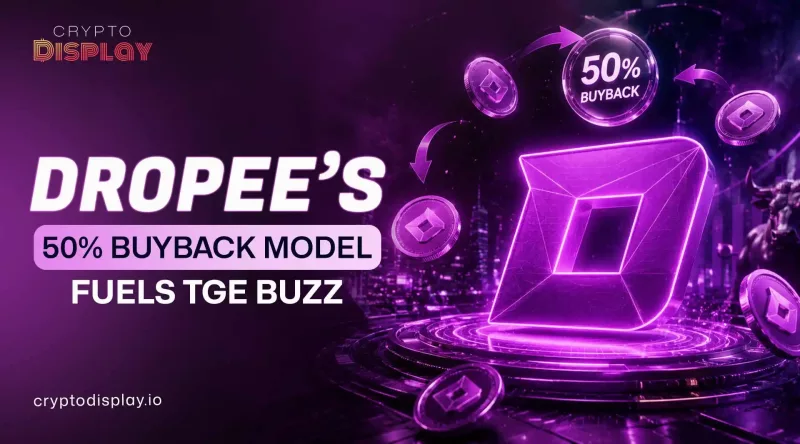
Dropee TGE Launches a Revenue Model Backed by Real Platform Growth
There are moments in technology when a single announcement stops the room. For the Telegram mini-app ecosystem, that moment arrived on May 27, 2025 the day Dropee officially launched its Token Generation Event (TGE) for $DROPEE, the native currency powering what the company calls the world's first autonomous app-creation platform.
The timing is deliberate. Telegram has quietly grown into one of the most fertile grounds for app development anywhere on the internet, with its mini-app infrastructure giving developers a direct pipeline into hundreds of millions of active users. Dropee is betting that most of those potential creators are not developers at all and that the gap between an idea and a live, monetized app should not be measured in months of coding but in minutes of conversation.
The numbers already tell part of the story. Before today's TGE, Dropee's platform has attracted 13 million active users and generated more than $2.5 million in ecosystem revenue. Thousands of mini-apps have already been built and deployed using Dropee's infrastructure. These are not projections or aspirations. They are baseline figures from which the company now intends to scale.
What makes it different is not just the technology. It is the economic architecture underneath it, a model where the platform's success and the token holder's success are structurally intertwined, not loosely correlated.
What Dropee Actually Builds
It is not a crypto project that happens to have a Telegram channel. It is, fundamentally, an infrastructure company, one that has built a pipeline to take any app concept from idea to a fully deployed, live Telegram mini-app, complete with narrative design, visual assets, and a monetization layer, all generated automatically.
The company's own description is worth sitting with: "We build Apps from concept to code narrative, assets, and monetization automatically. The future of app studios isn't teams; it's algorithms." This is a provocative claim, and in most contexts it would invite skepticism. But it is not making it from a standing start. The platform is already live, already generating revenue, and already hosting thousands of deployed applications.
The target environment is Telegram's mini-app ecosystem, a platform that sits inside one of the world's most downloaded messaging applications and gives developers native access to Telegram's enormous, globally distributed user base. Building a mini-app traditionally requires a competent development team, significant upfront cost, and months of iteration before a product is ready to monetize. Dropee's platform collapses that timeline, allowing creators, including those with no technical background, to deploy functional, monetizable mini-apps directly into the Telegram environment.
From the official website: "We're building the world's first tool to create, deploy, and distribute mini-apps on Telegram, and $DROPEE will be the heart of our ecosystem. Empowering the next generation of Telegram creators. Massive announcements drop soon."
The TGE: Why May 27 Matters
Token Generation Events have become a familiar fixture of the Web3 calendar, but not all TGEs are equal. What distinguishes the $DROPEE TGE is the foundation it stands on. This is not a project launching a token in the hope of building a product afterward. Dropee already has a product, already has users, and already has revenue. The token launch is the next phase of a platform that is already functioning and functioning at scale.
The $DROPEE token is positioned as the heart of the ecosystem. That phrase carries specific meaning here. The token is not a governance instrument sitting at the edge of Dropee's economics. It is the mechanism through which the platform's commercial activity flows back to the people who hold it.
"Every mini-app monetized. Every dollar the platform earns. Half comes back to $DROPEE permanently."
The announcement from the official account put it plainly: buybacks are coming. Up to 50 percent of all Ecosystem Revenue will flow back into the token permanently. This is not a temporary incentive or a time-limited promotion. It is a structural commitment, a pledge that as the ecosystem grows, half of what it earns returns to token holders indefinitely.
The Buyback Model: Breaking Down the Economics
In traditional markets, buybacks are one of the most reliable signals a company can send. They indicate that the underlying asset has strong future earnings and that returning capital to holders is the best use of available cash. It is applying an analogous logic to its token economy.
Every mini-app on the platform generates revenue. Every dollar that flows through the ecosystem is now partially committed to the token. With 13 million active users already on the platform and thousands of apps already monetizing, the pool from which buybacks will draw is not hypothetical. It is active and growing.
The mechanics are straightforward: as the platform earns, half of that earning is deployed to support the token. More apps built means more revenue. More revenue means more buybacks. For holders, this creates a direct economic relationship between the platform's commercial success and their own position not mediated by speculative market sentiment alone but tied to real, recurring platform activity.
This model creates a powerful incentive for Dropee to keep growing its creator base. The company's revenue is tied to app activity. Buybacks are tied to revenue. Token value is tied to buybacks. Every new creator on the platform, every new mini-app deployed, every new user attracted feeds directly into this cycle.
13 Million Users — and What Comes Next
The most grounding number in the Dropee story is 13 million active users. In a space where many projects launch with user projections and roadmaps, it is arriving at its TGE with a live, active community of that size already engaged with the platform. Combined with $2.5 million in ecosystem revenue already generated, the baseline for the buyback model is already established.
But the company is not treating these figures as an endpoint. Thousands more apps are coming with Dropee Create, the platform's content-generation and deployment tool that allows creators to build Telegram mini-apps from concept to live product without needing a single line of custom code. As more creators join, the app catalog grows. As the catalogue grows, more users are drawn in. As more users engage, more revenue is generated. As more revenue is generated, more buybacks are executed.
This is the flywheel Dropee has designed. The TGE is the moment it goes public and the point at which outside participants can position themselves inside that loop rather than simply watching it from a distance.
The Bigger Picture: Telegram as a Creator Economy
Zoom out and Dropee's ambition becomes even clearer. Telegram has never been positioned as a creator economy platform. It is a messaging app, an extraordinarily popular one, with a user base that rivals any social media platform on earth. But its mini-app infrastructure creates the structural possibility for something new: a creator economy built on top of a messaging layer, with direct access to an enormous, already-engaged audience.
It is attempting to be the foundational infrastructure for that economy. Not competing with Telegram, but building the layer that allows creators to fully exploit it. The company provides the creation tools, the deployment pipeline, and now the economic infrastructure for the token that sits at the center of how value flows through the ecosystem.
For independent creators, this means an unprecedented proposition: build a monetizable app for one of the world's largest messaging platforms, without a development team, without months of preparation, and with a platform-native economic system designed to grow alongside you. For token holders, it means a stake in the infrastructure that every one of those creators depends on and a direct share in the revenue their activity generates.
What to Watch Going Forward
Dropee has promised that massive announcements are still incoming. The TGE launch on May 27 is the headline event, but it is also the starting line. The buyback mechanism goes live as part of this rollout, and with it, the live relationship between ecosystem revenue and token value begins in earnest.
The questions worth tracking are straightforward. How quickly does the creator base grow now that the platform is in the spotlight? How does the app catalogue expand as Dropee Create scales? And how does the buyback mechanism behave as revenue, already at $2.5 million and climbing, continues to grow?
For a platform with 13 million active users, thousands of deployed apps, and a structural commitment to returning half its earnings to token holders permanently, those are not abstract questions. They are the metrics of a real business, measured in real activity, with real financial consequences for everyone in the ecosystem.
The TGE is not just a token launch. It is the public opening of an economic system that was already in motion and an invitation to join it before the next phase of that motion begins.


Frequently Asked Questions
 Explore Our FAQs
Find quick answers to commonly asked questions and understand how things work around here.