
How Centralized Exchanges Store and Secure User Funds Safely

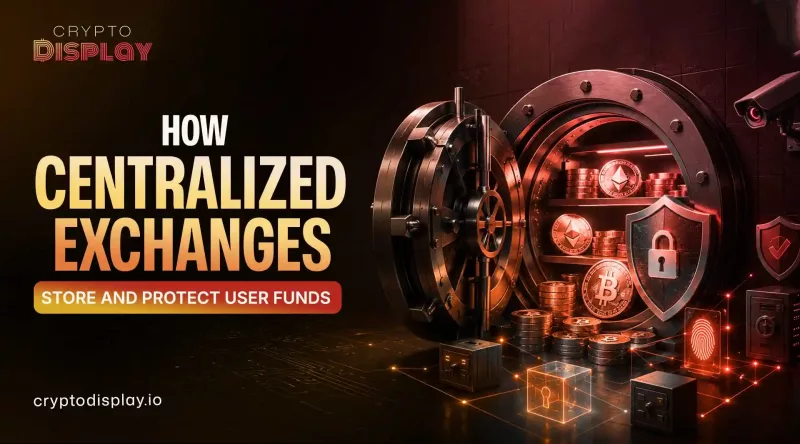
How Centralized Exchanges Store and Protect User Funds Explained
Centralized exchanges hold billions in user funds every day. They use a mix of hot wallets and cold storage to keep assets safe. Hot wallets handle daily trading liquidity, while cold wallets stay offline to reduce hacking risk. Strong systems help balance speed, access, and security for users.
These platforms also use advanced protection layers like multi-signature approvals, encryption, and constant monitoring. Regular security audits and internal controls reduce risks from attacks or insider threats. Together, these measures aim to keep user funds safe while still allowing smooth trading and fast withdrawals when needed.
How Centralized Exchanges Store and Protect User Funds
Every time you deposit a crypto project on Binance, Coinbase, or Kraken, you're handing custody of that asset to a company. You trust them completely. But most users have no idea what happens to their funds after that deposit hits. The answer is more complex than most people expect and a lot more important after the FTX collapse wiped out billions in user assets overnight.
What "Custody" Actually Means on a CEX
When you buy Bitcoin on a centralized exchange, you don't hold the private keys. The exchange does. Your account balance is essentially an IOU number in their database that says they owe you that amount.
This is called custodial storage. The exchange controls the actual wallets where your crypto sits. You control only your login credentials. That's not automatically bad. Banks work the same way. The real question is: what does the exchange do with those funds once they have them?
The Cold Wallet vs Hot Wallet Split
This is the most important technical layer in exchange security. Most reputable CEXs split user funds into two buckets.
Hot wallets are connected to the internet. They hold a small percentage of total funds usually 2% to 5% to cover daily withdrawals. They're fast but vulnerable. If a hacker gets in, hot wallet funds are at risk.
Cold wallets hold the bulk of user assets, often 90% to 98%. These are offline storage systems, sometimes physical hardware wallets or air-gapped computers, stored in secure vaults. No internet connection means no remote hack is possible.
Coinbase publicly states it keeps around 98% of customer crypto in cold storage. Kraken uses a similar structure with geographically distributed vaults. Binance has never fully disclosed its split, which has drawn criticism from security researchers.
The logic here is simple: limit what a hacker can reach. Even if they breach the exchange's system, they can only access the hot wallet which is a fraction of the total.
Multi-Signature Wallets: Who Actually Controls the Keys
Cold wallets at major exchanges don't work with a single private key. That would create a single point of failure: one person gets compromised, everything is gone.
Instead, exchanges use multi-signature wallets. These require multiple private key holders to sign off before any transaction can move. Think of it like a bank vault that needs three different keys from three different people simultaneously.
This way, no single employee, even a senior executive, can unilaterally move funds. It also means that if one keyholder is compromised, the system doesn't break down.
Insurance Funds: What Happens If Things Go Wrong
A well-run exchange doesn't just try to prevent losses it prepares for them. Coinbase holds FDIC insurance on USD balances (up to $250,000), though this does not cover crypto holdings. For crypto, they maintain commercial crime insurance policies, though the coverage limits are not publicly disclosed, and smart contract risks are generally not covered.
Binance runs the SAFU (Secure Asset Fund for Users), a reserve fund built from 10% of trading fees. In 2022, Binance disclosed the SAFU held over $1 billion, though it has since fluctuated with market conditions. The fund was used in 2019 after a $40 million hack to fully reimburse affected users.
Kraken, BitMEX, and OKX maintain similar reserve mechanisms. The key variable is whether these funds are independently audited and many are not, especially when it comes to verifying exposure from smart contract risks, custody systems, and internal security events.
Proof of Reserves: The Transparency Gap
After FTX collapsed in November 2022, the crypto industry realized that "trust us" was not good enough. Exchanges claimed to hold user assets. Some didn't.
Proof of Reserves (PoR) is a verification method where exchanges publish cryptographic proof that they hold at least as much in assets as they owe to users. It uses a system called a Merkle tree, which lets you verify your account is included in the total without exposing anyone else's data.
Binance, Kraken, and Bybit have all published PoR reports. But critics point out that PoR only proves assets exist at a single point in time; it doesn't prove the exchange isn't using those assets as collateral for loans elsewhere.
Real transparency would require full, regular audits by independent firms. Most crypto exchanges haven't gone that far yet.
What Users Can Actually Do to Reduce Risk
Knowing how exchanges work changes how you should use them.
- Don't store long-term holdings on any CEX- Use a hardware wallet like Ledger or Trezor for anything you're not actively trading.
- Check if the exchange has published PoR- If they haven't, that's information worth acting on.
- Spread across exchanges- Don't keep everything in one place, even if it's a major platform.
- Verify jurisdiction- A regulated exchange with an audited reserve is materially safer than one operating from an undefined offshore base.
The Bottom Line
No exchange is risk-free. But the gap between a well-structured CEX and a poorly managed one is enormous. Cold storage ratios, multisig architecture, insurance funds, PoR transparency, and regulatory oversight aren't just technical details. They're the difference between your funds being safe and them disappearing as FTX users' money did.
Disclaimer
This article is for informational purposes only and does not constitute financial or investment advice. Cryptocurrency markets carry significant risk. Always do your own research before making any financial decisions.




Frequently Asked Questions
 Explore Our FAQs
Find quick answers to commonly asked questions and understand how things work around here.