Remittix PayFi Explained: How Crypto Reaches a Bank Account

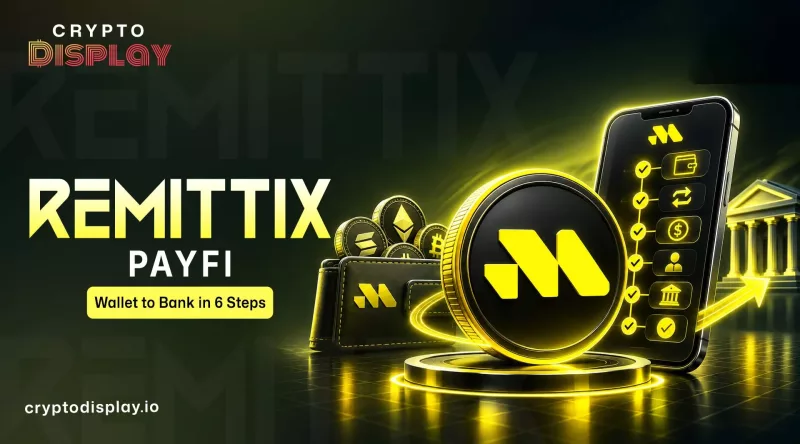
Remittix PayFi Lifecycle: Wallet, Earn, and Fiat Payout Steps
The RTX launch is scheduled for November 24, today, and most headlines focus on price targets. A better question is what the product actually does.
Remittix PayFi is meant to move crypto into a bank account in local currency, and the steps around it matter as much as the token. This guide walks through the full path and flags what is still unproven.
Key Takeaways
- The official lifecycle has six steps, from wallet download to a bank payout.
- The platform describes 40+ fiat currencies, which still needs confirmation per route.
- Testing was limited to about 1,000 invited users at last report.
- Earn rates reach up to 17.4% APY but are not guaranteed, with a 30-day lock in the project's own pool.
- A token listing does not prove that payouts work.
Remittix PayFi Lifecycle: Wallet, Earn and Fiat Payout Steps
The project's own Education Centre lays out the journey in six steps: Download the wallet, buy crypto, use it, grow it, convert it to fiat, and get paid to a bank account. It lists non-custodial storage, lower fees, and 24/7 support as core features and says money can move to more than 40 fiat currencies.
Treat that page as a description of the design, not proof that every step works for every user today.
Step One: Why Does the Wallet Come First?
Everything in Remittix PayFi starts in a non-custodial wallet, which means you hold the keys instead of a company. That gives control, but it also means a lost recovery phrase cannot be fixed by support.
If hot and cold storage are new to you, these crypto wallet basics explain the difference in plain language. Earlier reports said an iOS version was out while Android was still in development.
How Does Buying Crypto Work Inside the Platform?
Step two is buying crypto through the app. The company materials list USDT and USDC on Ethereum, Celo, Base, and Polygon as payment rails. These are company-reported details, so confirm the current list in the app before you send anything.
Stablecoins behave differently depending on who issues them and how reserves are held. This USDC and USDT comparison covers transparency, liquidity, and custody.
Where Do Markets and Earn Fit in the Cycle?
Steps three and four are about using and growing holdings. Markets is a perpetual futures venue on Arbitrum, which carries high risk and is not a savings tool. Earn is the yield option, with rates up to 17.4% APY, first reward claims after seven days, and withdrawals after 30 days in the project's own pool.
Our Earn launch update breaks down the pool rules. A displayed rate can change, and it is never a promise.
How Does Crypto Become Fiat in a Bank Account?
The last two steps are the reason the project exists. A sender pays in crypto, outside providers handle compliance and settlement, and the receiver gets local currency in a bank account. That payout leg is the hardest part of any payment product, because banks, regulators, and local rails all have their own rules.
Check the current corridors and limits on the official website before relying on any route. Remittix PayFi should be judged by completed payouts, not by diagrams.
What Is Still in Testing Before Full Launch?
At the last report, Remittix PayFi was in testing with roughly 1,000 invited users sending EUR and USD payments. That is a small group compared with the number of presale buyers, so wider access is the next milestone to watch.
The earlier launch readiness report tracks which products were live, partly live or still planned, and it shows why the token and the product are on different timelines.
What Should You Check on Launch Day?
Trading and payments are separate events. A token listing says nothing about whether payouts work, so verify exchange announcements, claim steps and product access one at a time, and ignore direct messages that offer help.
Our pre-launch checklist covers dates, claims, and safety. In short, Remittix PayFi is worth following only as far as official sources and live payouts confirm it.
Disclaimer
This article is for information only and is not financial, investment, legal, or tax advice. Cryptocurrency presales, newly listed tokens, yield products, and futures trading carry high risk, including the total loss of funds. Features, rates, supported currencies, and dates can change without notice, and several figures here are company-reported and not independently verified