
Web3 and DeFi Explained: How They Work and Why They Matter

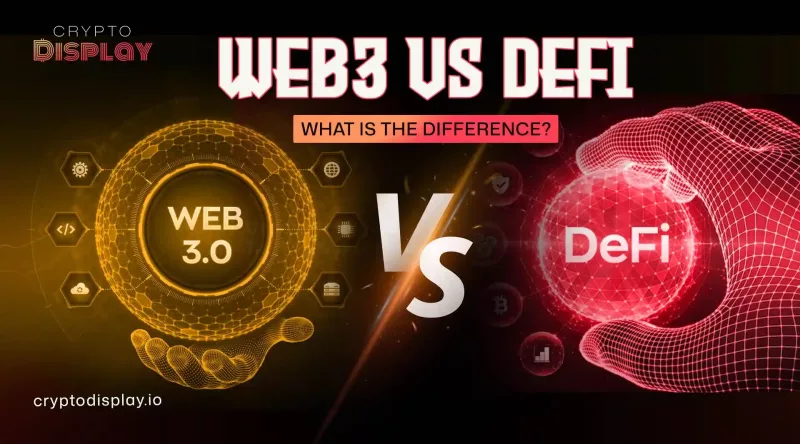
Web3 vs DeFi: Understanding Their Role in Today’s Crypto Market
Two words come up again and again when people talk about crypto and blockchain- Web3 and DeFi. Most people use them like they mean the same thing. They do not.
Both ideas are connected. Both run on blockchain technology. But they are not the same- and knowing the difference helps you make smarter decisions about how you use and invest in crypto.
This guide explains web3 and DeFi in simple terms, shows how they work together, and lays out exactly where they are different.
What Is Web 3?
Think about the internet you use every day. You open Instagram, search on Google, or shop on Amazon. These platforms own your data. They decide what you see. They profit from your activity. You have very little control over any of it.
That is the globe as it exists today-called Weeb2.
Web 3 represents the next generation of the internet. It uses blockchain technology to give users real control over their own data, identity, and digital activity - shifting power away from big corporations and back to individual people.
To understand where things are heading, explore the future of Web 3 and how it may reshape the internet.
In simple words - Web3 is the idea of an internet you actually own.
In Web 3, applications run on decentralized networks rather than company-owned servers. Users control what they share, who sees it, and how it is used - without needing permission from Facebook, Google, or any other central authority.
It covers a very wide area. It includes social media apps that nobody owns, storage systems that spread your files across thousands of computers, games where you truly own your items, and digital identities that live in your wallet-not on a company's database.
What Is DeFi?
Decentralized finance is a type of financial system that runs without central authorities like banks or brokerages. It lets users lend, borrow, trade, and earn interest directly with one another using smart contracts.
If you are new, it helps to first understand what DeFi is and how it works before exploring advanced tools.
A smart contract is a piece of code that runs automatically on a blockchain. When certain conditions are met, the contract carries out a transaction on its own - no bank employee, no approval process, no waiting days for a transfer to clear.
Decentralized platforms operate on decentralized networks where no single person or company is in control. Every transaction is recorded publicly on the blockchain, meaning anyone can check and verify what happened - making the whole system far more transparent than traditional banking.
Some examples in action right now:
- Uniswap and PancakeSwap-decentralized exchanges where people swap crypto tokens directly, with no company in the middle
- Aave and Compound- platforms where you can lend your crypto and earn interest, or borrow against your holdings
- MakerDAO- a system that lets users create stablecoins by locking up crypto as security
The total value locked inside DeFi protocols reached over $100 billion in 2024- compared to just $300 million in early 2019. That rapid growth shows just how fast people are adopting these open financial tools.
How Web3 and DeFi Connect
Here is the simple way to picture it.
Web 3 is the whole house. Decentralised finance is one of the most important rooms inside that house.
Decentralised finance is a subcategory within the broader Web3 space. It offers many of the services that traditional financial institutions provide - but in a way controlled by users and communities rather than a central entity.
You cannot have Web3 and DeFi separately. The open, decentralized infrastructure of Web-3 is exactly what makes decentalized finance possible. Smart contracts, blockchain networks, and user-owned wallets are all Web 3 tools - and DeFi uses all of them to build financial products.
But Web 3 goes far beyond finance. It covers gaming, storage, social media, identity, governance, and much more. Decentralized finance is focused entirely on money and financial services.
Web3 and DeFi - Side by Side
|
Feature |
Web3 |
DeFi |
|
What it is |
The next generation of the internet |
A financial system without banks |
|
Main focus |
Data ownership, apps, identity, internet |
Lending, borrowing, trading, earning |
|
Built on |
Blockchain and decentralized networks |
Smart contracts on blockchain |
|
Scope |
Very broad- covers the whole internet |
Specific- focused on finance only |
|
Key tools |
dApps, NFTs, DAOs, decentralized storage |
DEXs, lending pools, stablecoins |
|
Who controls it |
No central authority-users do |
No central authority- smart contracts do |
|
Examples |
Ethereum, Filecoin, ENS, Lens Protocol |
Uniswap, Aave, MakerDAO, Compound |
|
Relationship |
The bigger category |
A part of Web-3 |
Key Differences Explained Simply
- Scope- Web3 encompasses a broad vision of a decentralized internet that extends beyond finance to include social networks, identity management, and decentralized storage. DeFi is specifically focused on rebuilding financial services without traditional intermediaries.
- Purpose- Web-3 gives people ownership of the internet itself. DeFinance gives people ownership of their financial activity. One is about data and identity. The other is about money and transactions.
- Building blocks-The main difference between Web3 and DeFinance is that DeFinance is built on top of existing smart contract platforms like Ethereum, while Web3 is built on the internet itself- using smart contracts as one tool among many.
- Who uses them- Web-3 tools are used by gamers, creators, developers, and communities who want ownership of their digital lives. DeFinanace is used by traders, savers, borrowers, and investors who want financial services with no middlemen.
What They Share
Even though Web3 and DeFi are different, they sit on the same foundation and share important qualities.
Both are permissionless-meaning no one needs approval from a central authority to join or use them. Both are decentralized, running on networks spread across thousands of computers worldwide and both use blockchain technology as their base layer for security and transparency.
They also share a common goal- returning control to regular people. It does this for the internet as a whole. DeFinance does it specifically for money.
Real-World Examples to Make It Click
Web 3 example- You create a digital identity stored in your crypto wallet. No company owns it. You use it to log into apps, prove ownership of digital items, and vote in online communities- all without a username or password controlled by anyone else.
De-Fi example- You have 1 ETH sitting idle. You deposit it into Aave, a lending platform. Another person borrows it by putting up their own crypto as security. You earn interest automatically every day - no bank involved, no paperwork, no waiting.
Both of these experiences are only possible because of blockchain. But one is a Web3 application and one is a DeFi product.
You can also explore best DeFi tokens to watch if you want to see which projects are gaining real traction.
Why This Difference Matters
Understanding the gap between these two ideas helps in several practical ways.
If you are looking to earn passive income from your crypto holdings, you are looking at De-Fi. If you are interested in owning digital assets, joining online communities with real governance rights, or building apps nobody controls, you are stepping into the broader world.
Web-3 technology enhances DeFi's decentralised and secure nature, allowing for greater trust, transparency and accessibility throughout the financial system.
They support each other. Better infrastructure means, better DeFi tools. More DeFi activity drives up demand for development.
This growth also highlights the future of DeFi in 2026 and how fast this space is evolving.
Final Thoughts
Web3 and DeFi are not the same thing- but they are deeply connected.
Web3 is the big picture. It is a new kind of internet where users own their data, their identity and their digital lives. DeFinance is one of the most powerful ideas inside that picture - a financial system with no banks, no brokers, and no gatekeepers.
Learning the difference between the two helps you navigate the crypto space with much more confidence. You will know which tools solve which problems - and which opportunities match what you are actually looking for.
Both are still growing fast. Both carry real risk. And both represent a genuine shift in how the world will use the internet and manage money in the years ahead.
This blog is for educational purposes only. Not financial advice. Always do your own research before making any investment decisions.

Frequently Asked Questions
 Explore Our FAQs
Find quick answers to commonly asked questions and understand how things work around here.