What Is the Difference Between ICO, IEO, and IDO in Crypto?

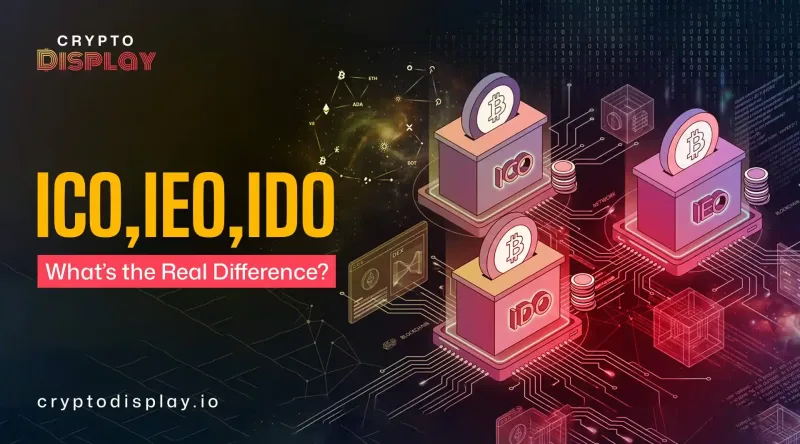
How ICO, IEO, and IDO Token Sales Really Work in Crypto Investing
Have you ever seen the words ICO, IEO, and IDO on a crypto website and had no idea what they mean? You are not alone. These three words get used a lot in the crypto world. But most people do not really know what they mean or how they are different from each other.
The good news is they are not that hard to understand once someone explains them in simple words. That is exactly what this article is going to do.
By the end of this blog you will know exactly what ICO, IEO, and IDO mean, how each one works, and which one might be the best choice for investors like you.
Let us get started.
What Is a Token Sale?
Before we talk about ICO, IEO, and IDO, you need to understand one basic idea.
When a crypto project needs money to build their product, they sell tokens to the public. Think of a token like a ticket. You buy the ticket early, before the show starts, at a cheap price. Later, when the show becomes popular, your ticket becomes more valuable.
This process of selling tokens to raise money is called a token sale.
ICO, IEO, and IDO are just three different ways to do a token sale. Each one works a little differently. Each one has different risks and rewards.
Now let us look at each one.
What Is an ICO - Initial Coin Offering?
It stands for Initial Coin Offering.
Think of it like a crowdfunding campaign. A crypto project says - "We have a great idea. Give us money and we will give you tokens in return."
Anyone with crypto can buy into an ICO directly from the project team. There is no middleman. No exchanges. No gatekeeper.
ICOs were extremely popular in 2017 and 2018. Projects raised millions of dollars in just a few hours. Some of the biggest names in crypto - like Ethereum itself - started with an ICO. For a modern example, you can read our Tezverse ICO review to see how new token launches are structured in the metaverse space.
How Does an ICO Work?
- The project releases a whitepaper explaining their idea
- They set a token price and a fundraising goal
- Investors send crypto directly to the project's wallet
- In return, they receive tokens
Pros and Cons ofICO
|
Pros |
Cons |
|
Open to everyone worldwide |
No regulation or oversight |
|
Easy to participate |
High risk of scams and fraud |
|
Low entry price for early investors |
Many projects disappeared with funds |
|
No need for an exchanges |
No protection for buyers |
The biggest problem withICOs is that anyone can launch one. There is no one checking if the project is real or if the team can be trusted. This led to a lot of scams in 2017 and 2018 where projects took people's money and vanished. You can also explore our updated list of top crypto ICOs in 2026 to find promising projects before they hit major exchanges.
What Is an IEO - Initial Exchange Offering?
IEO stands for Initial Exchange Offering.
An IEO is like an ICO but with one big difference - a crypto-exchange runs the token sale instead of the project itself.
Think of it this way. In an ICO, you buy directly from a stranger on the street. In an IEO, you buy from a trusted shop that has already checked the product for you.
The exchange acts as a middleman. Before they agree to host the IEO, they review the project, check the team, and make sure everything looks legitimate. This adds a layer of trust and safety that ICOs do not have.
Popular exchanges that run IEOs include Binance Launchpad, P2B, KuCoin Spotlight, and others. If you prefer exchange-backed launches, you can check our list of upcoming crypto IEOs currently hosted on major trading platforms.
How Does an IEO Work?
- A crypto project applies to an-exchange to host their sale
- The exchange reviews and approves the project
- Users on that trade site can buy the tokens directly on the platform
- The trading site usually lists the token right after the sale ends
Pros and Cons of IEO
|
Pros |
Cons |
|
Exchange checks the project first |
Only available to users of that site |
|
Much safer than an ICO |
Exchange-takes a fee from the venture |
|
Tokens gets listed on the-exchange quickly |
Fewer projects get approved |
|
Built-in user base from the exchange |
Still carries investment risk |
IEOs became popular after 2019 as people started looking for safer ways to invest in new projects. The exchange's reputation is on the line, so they only list projects they believe in.
What Is an IDO - Initial DEX Offering?
IDO stands for Initial DEX Offering.
A DEX is a Decentralized Exchange- like Uniswap, PancakeSwap, or SushiSwap. These are exchanges that have no central owner. They run on smart contracts and are open to everyone.
It is a sale that happens on one of these decentralized exchanges. There is no company in charge. Everything runs automatically through code.
IDOs became popular in 2020 and 2021 during the DeFi boom. They are faster to launch, cheaper to set up, and open to anyone in the world. If you are comfortable with DeFi tools, explore our list of upcoming IDO launches to discover decentralized token sales happening now.
How Does an IDO Work?
- A venture launches their token on a DEX or a launchpad platform
- A liquidity pool is created — this lets people buy and sell the token right away
- Investors connect their crypto wallet and buy the token
- Trading starts instantly, sometimes within minutes of the sale
Pros and Cons of IDO
|
Pros |
Cons |
|
Open and decentralized — anyone can join |
Less vetting than an IEO |
|
Trading starts immediately |
Can be subject to bots and price manipulation |
|
No need to register on a central exchange |
Smart contract bugs can be a risk |
|
Lower cost to launch for projects |
Can be overwhelming for beginners |
IDOs are fast and open, but that also means they can be risky. Since there is less checking involved, you need to do your own research before joining an IDO.
ICO vs IEO vs IDO- Side by Side
Here is a simple table that puts all three together so you can see the differences clearly:
|
Feature |
ICO |
IEO |
IDO |
|
Full Name |
Initial Coin Offering |
Initial Exchange Offering |
Initial DEX Offering |
|
Where It Happens |
The project's own website |
Centralized exchange |
Decentralized exchange |
|
Who Runs It |
The venture team |
A crypto exchange |
Smart contract / DEX |
|
Level of Trust |
Low |
High |
Medium |
|
Regulation |
None |
Some |
None |
|
Speed of Trading |
Slow |
Fast |
Very Fast |
|
Risk Level |
High |
Medium |
Medium |
|
Best For |
High risk takers |
Safer investors |
DeFi users |
|
Famous Example |
Ethereum (2014) |
Binance Launchpad |
Uniswap launches |
Which One Is Best for You?
The answer depends on who you are and how much risk you can handle.
If you are a complete beginner, an IEO is probably the safest place to start. The exchange has already done some checking for you. The process is simple and familiar. You do not need to understand DeFi or smart contracts.
If you are comfortable with DeFi and wallets, an IDO can be exciting. You get access to very early projects and trading starts fast. But make sure you research the venture properly before putting in money.
If you are an experienced crypto investor who understands the risks and wants the highest possible early entry price, an ICO still offer big opportunities but always check the team, the whitepaper, and the community before investing.
3 Golden Rules Before Investing in Any Sale
No matter which type of sale you choose - ICO, IEO, and IDO- always follow these three rules:
- Rule 1 - Read the Whitepaper The whitepaper is the project's official document. It explains what the venture does, how the it works, and what the team plans to build. If there is no whitepaper, walk away.
- Rule 2 - Check the Team Look up the founders and developers. Are they real people? Do they have a track record? Anonymous teams are a red flag.
- Rule 3 - Never Invest More Than You Can Lose - sales are high risk. Prices can go to zero. Only invest money you can afford to lose completely.
Final Thoughts
ICO, IEO, and IDO are all ways for cryptocurrency projects to raise money from the public. They each work differently and carry different levels of risk.
An is the most open but also the most risky. An IEO is safer because an exchange checks the venture first. An IDO is fast and decentralized but requires you to understand DeFi.
Disclaimer
Always do your research. Start small. And never invest more than you can afford to lose.