
Autheo Introduces Decentralized OS for Web, Blockchain & AI

Sheridan, USA / Wyoming, June 30th, 2026, Chainwire
Five years in the making, Autheo is launching its decentralized operating system on Mainnet after public testnet adoption surpassed 1.8 million wallets, nearly 1 million smart contracts, and 8.8 million transactions.
Autheo today formally introduced its decentralized operating system to the public: a coordination layer designed to let the traditional Web, blockchain networks, and AI agents interoperate natively as a single system. The company is now launching its Mainnet the production environment for the network after more than a year of public testnet activity.
THE COORDINATION LAYER THE INTERNET NEVER HAD
The big net wars took place long ago. They were in the 1980s and 1990s. They set one key rule for the web. The rule is still used to this day. The rule is this: net links come from real tools. They do not come from big boss plans.
Some key tools won the race. TCP/IP was one of them. DNS was one of them. HTTP was one of them. TLS was one of them. These tools worked well in real life. They were put to use with ease. The whole web still runs on them. The coin world took a new path. Each net worked on its own. Each had its own safe guard. Each had its own vote rules. Each had its own code tools. Each had its own build kits. Now these nets do not talk well. They are like small islands alone. They do not share with each other.
The new AI bots make this worse. There are more and more of them. They need to work on all nets. They need the web and coins and AI. But these nets were not made to work as one. They do not know how to join up.
Protocols such as IBC, LayerZero, CCIP, Wormhole, and Axelar have made meaningful progress on chain-to-chain messaging and asset transfer — but those efforts operate at the bridging layer. Autheo addresses the problem from a different angle: a shared substrate where Web services, blockchain networks, and AI agents coordinate natively on a common identity, communications, execution, and infrastructure layer, rather than relying on bridges that pass messages between otherwise disconnected systems.
At the same time, approximately three-quarters of business applications today are delivered as SaaS, and identity, storage, compute, payments, and messaging already run as distributed services across the Web. The Internet, in other words, has quietly taken on many of the functions of an operating system. What it has lacked is the layer that lets those services together with blockchain networks and AI agents interoperate by default, rather than through one-off, brittle integrations built per partner, per protocol, and per chain.
Autheo has one main job. It helps all parts work as one. It makes them run and talk to each other. The Autheo OS gives you key tools. These are like a PC's core tools. You get ID and time slots. You get notes and state. You get math and save space. You get run and do tasks. All these are open for use. Any app or tool can call on them. The big goal is a joint base. Web2 sites can work on it. Web3 nets can work on it. AI bots can work on it too. They can trade and team up. They do not need to know where the other side is. For AI bots that work on their own, Autheo has a key guard. It is a trust and ID layer on the chain. It can fight off new big math threats. Bots can hold their own passes. They can sign their own deals. They can call on all the tools. They do not need to use outside help. They do not show their own keys.
“We didn’t set out to build just another network,” said Scott Bayless, Managing Director and co-founder of Autheo. “We set out to find the right relation between the ones we already have. A body has many parts. A city is many trades. The Internet today is many systems — each doing its work, none of them moving as one. With Mainnet now live, Autheo is the layer where the web, the chain, and the agent can finally work together.”
FOUNDED BY LONG-TIME COLLABORATORS
Autheo was founded in July 2021 by Todd Mortenson and Scott Bayless, long-time collaborators who have built and operated multiple ventures together over the past two decades.
The founders shared a simple thesis: the next phase of the Internet will be defined less by any single technology and more by the coordination layer that enables the traditional Web, blockchain networks, and AI to operate as a single system. Much of what ultimately matters in technology tends to begin far from the loudest places — quietly, slowly, by those who would not have been the obvious choices.
The team had a clear guide. It was their big goal. The founders and tech leads did deep work. They spent years on their hard task. They looked at nets and whole worlds. They looked at how chains are built. They looked at new ways to show who you are. They looked at safe guards for the new math age. They looked at how to run things with no one boss.
Then they built Autheo from the ground up. They used four main base parts. The first part is TheoID. It is a W3C-style ID. It works for all users and bots. It is the main way to show who you are. The second part is PQCNet. It is a safe talk and ID web. It uses new math from NIST. The tools are ML-KEM and ML-DSA. They also use SLH-DSA. These are top safe guards. The third part is a Cosmos SDK base. It is called Layer 0. It has IBC built right in. This lets chains talk to each other. The fourth part is an EVM base. It works like the top chain. It runs on a Proof-of-Stake vote. You can give your vote to others. Only ok'd groups can vote on it. CometBFT makes sure each block is firm. This is called "Proof of Autheo."
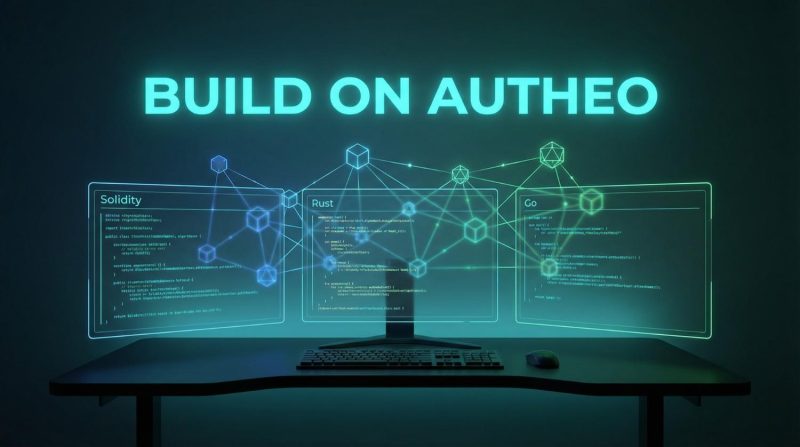
Solidity smart contracts can be deployed natively on Autheo or migrated from existing EVM-compatible chains, providing developers with a familiar development environment while benefiting from native IBC interoperability across the broader blockchain ecosystem.
The research and development underlying the platform has also resulted in an expanding portfolio of patent families covering core architectural innovations, reflecting the team’s long-term intellectual property strategy surrounding decentralized operating systems, digital identity, interoperability, post-quantum security, and related technologies.
Network engineering and Autheo’s post-quantum security architecture are led by Chief Engineering Officer Kenneth Harper, who has overseen the design, architecture, and implementation of the platform through public testnet and into Mainnet launch. Supporting those efforts is a multidisciplinary organization spanning engineering, product, project management, quality assurance, infrastructure, operations, ecosystem development, developer support, business development, partnerships, marketing, global channels, finance, legal, compliance, and intellectual property. Autheo’s broader contributor base spans approximately 100 people across 25 countries — blockchain pioneers, Fortune 500 operators, and researchers from institutions including MIT, Harvard, Stanford, and Caltech. Independent security audits have been completed by Halborn (testnet) and CertiK (Mainnet).
Autheo collaborates with leading infrastructure, security, and ecosystem partners including Zeeve, InfStones, Hydrex, Halborn, CertiK, TrustSwap, Team.Finance, Utila, Ape Bond, Antier, EVU, among others across validator and node operations, security audits, custody, token services, and ecosystem development.
TESTNET ADOPTION HAS COMPOUNDED
Autheo’s public testnet went live in 2025 and, over its first twelve months, attracted approximately 350,000 wallets and 60,000 smart contracts as developers stress-tested the network. Following the May 12, 2026, announcement of Mainnet Phase 1, adoption accelerated. In the roughly 45 days since, cumulative wallet addresses have grown more than 5x and smart contracts have grown more than 15x. As of today, cumulative testnet totals stand at:
- 1,812,088 wallet addresses
- 968,502 smart contracts
(Figures per Autheo network data, June 24, 2026. Independently verifiable on the public testnet explorer: testnet-explorer.autheo.com · verified contracts.)
Daily activity over the past month has averaged approximately 30,000 new wallet addresses and 20,000 new smart contracts. The Autheo testnet is now onboarding more wallets and deploying more contracts in a single day than it did across full months of its first year. Contract density at this stage is unusual for a Layer-1 testnet and reflects the breadth of developer use cases the team has supported across the build-out.
“Mainnet is live,” said Todd Mortenson, Managing Director and co-founder of Autheo. “The industry will be racing to retrofit post-quantum security ahead of NIST’s timeline — our developers won’t have to. We built PQC in from the ground up. One interface for Web services, on-chain protocols, and AI agents. One million human developers on-chain within three years. And the AI agents building alongside them? Orders of magnitude more. The coordination layer for that future is live today.”
WHAT’S NEXT
With the testnet validating the architecture and the Mainnet now launching, Autheo’s near-term focus is on expanding partnerships across the Web2, Web3, and AI communities and supporting builders deploying applications, agents, and protocols on the platform.
Developer Access (Mainnet, Live Today):
- Docs: docs.autheo.com
- Mainnet block explorer: evm-explorer.autheo.com
- Chain ID: 2127 (0x84f)
- Public RPC endpoints: rpc1.autheo.com · rpc2.autheo.com · rpc3.autheo.com
- API documentation: evm-explorer.autheo.com/api-docs
- GitHub: Public open-source release is in progress; commercial components remain in compartmentalized private repositories.
Testnet explorer (with verified-contract source): testnet-explorer.autheo.com
For developers seeking an early path into the Mainnet ecosystem, the Core Node and Prime Node tiers remain available at commerce.autheo.com (settlement via ETH on Arbitrum). These programs provide eligibility for long-term THEO token emissions, enabling developers to begin accumulating THEO for building, deploying, and participating in the network as the ecosystem expands. The Sovereign Validator Node program (399 nodes total) has its first 275 slots fully subscribed; the remaining 124 are reserved for enterprise partners and ecosystem customers. A dedicated builder portal at autheolabs.com is anticipated to launch, providing additional THEO token and validator allocations for projects deploying on the network.
THEO is anticipated to become available on Hydrex.fi in early July 2026, with additional exchange access expected to follow.
Additional documentation ecosystem, security, infrastructure, and listing announcements are expected over the coming weeks.
ABOUT AUTHEO
Autheo is building the Internet operating system — a decentralized coordination and execution layer that enables the traditional Web, blockchain networks, and AI agents to interoperate as a single system. The platform utilizes W3C Decentralized Identifiers (DIDs) as its native identity framework and is anchored by PQCNet, Autheo’s quantum-resistant communications and identity infrastructure built upon NIST-standardized post-quantum cryptography, including ML-KEM (FIPS 203), ML-DSA (FIPS 204), and SLH-DSA (FIPS 205). Operating alongside Autheo’s sovereign Cosmos-based Layer 0 and EVM-compatible Layer 1, PQCNet is designed to provide next-generation security for digital identity, communications, authentication, encryption, and trusted interactions across Web, blockchain, and AI ecosystems.
Autheo integrates a sovereign Cosmos SDK Layer 0 with native IBC interoperability and an EVM-compatible Layer 1 execution environment, allowing developers to deploy Solidity smart contracts natively or migrate existing applications from other EVM-compatible networks. Founded in July 2021 by Scott Bayless and Todd Mortenson, Autheo opened its public Testnet in 2025 and launched Mainnet in 2026.
For more information, visit autheo.com and follow Autheo on X at @Autheo_Network. Find the Media Kit at mediakit.autheo.com
Contact
Marketing & Media Relations
Ryan Teigen
Autheo LLC
ryan@autheo.com
608-713-1028



Frequently Asked Questions
 Explore Our FAQs
Find quick answers to commonly asked questions and understand how things work around here.