
How RWA Tokenization Can Change Traditional Financial Market

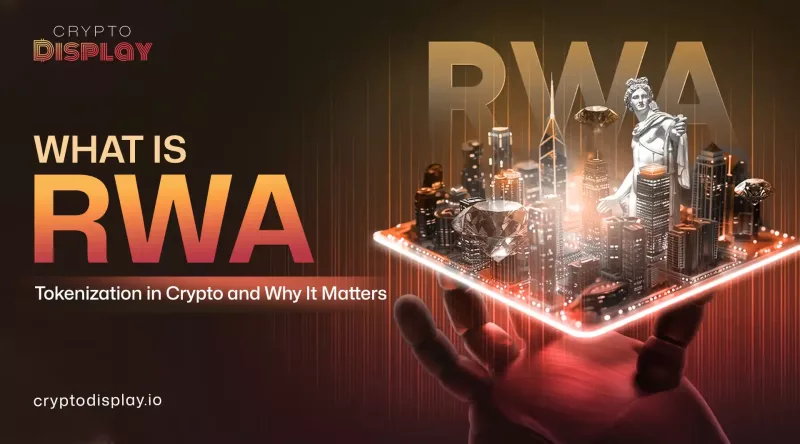
Why Real-World Asset Tokenization Is Getting Attention in Crypto
Imagine you want to invest in a building worth $10 million. You do not have $10 million. Most people do not. So you simply cannot invest right?
Wrong. Not anymore.
Thanks to something called RWA tokenization, that same building can now be divided into thousands of small digital pieces. You could own one piece for just $100. Welcome to one of the most exciting shifts happening in finance right now.
Let us break it all down in plain, simple language.
What Does RWA Mean?
RWA stands for Real-World Assets. These are things that exist in the physical world and have real value. Think of:
- Land and buildings
- Gold and silver
- Government bonds
- Company stocks
- Artwork and collectibles
- Business loans and invoices
These assets have existed for hundreds of years. But they have always had one big problem - they are hard to divide, slow to trade, and often only available to wealthy people or large institutions.
Tokenization changes all of that.
Readers who want to explore current real world asset (RWA) crypto projects can check how different platforms are bringing physical assets onto blockchain networks.
What Is Tokenization?
Tokenization means taking a real asset and creating a digital version of it on a blockchain. That digital version is called a token. The token represents ownership - just like holding a paper deed to a house, except it lives on the internet and can be sent anywhere in seconds.
Think of it like this. A pizza is hard to share if you only have one slice. But if you cut it into 100 pieces, suddenly 100 people can each have a part. Tokenization does the same thing to big, expensive assets. It cuts them into affordable digital pieces that anyone can buy, sell, or trade.
Each token is recorded on a blockchain -a public, permanent digital ledger. This means every transaction is transparent, traceable, and cannot be faked or erased.
How Big Is This Market?
This is not a small experiment. The numbers are growing fast.
According to a report by Boston Consulting Group, the market for tokenized real-world assets could reach $16 trillion by 2030. That would make it one of the largest financial markets on the planet.
Right now, the market has already crossed $15 billion in tokenized assets across categories like US Treasury bonds, private credit, real estate, and commodities. Major financial giants - including BlackRock, JPMorgan, and Franklin Templeton - have already launched their own tokenized products.
When the biggest banks in the world start moving, that tells you something important is happening.
How Does RWA Tokenization Actually Work?
Here is a simple step-by-step look at the RWA process:
Step 1-Pick the Asset A company or platform identifies a real-world asset. It could be a commercial property, a gold reserve, and a government bond.
Step 2 - Legal Wrapping Lawyers and financial experts create a legal structure that ties ownership of that asset to a set of digital tokens. This gives the token real legal standing.
Step 3- Mint the Tokens The tokens are created on a blockchain. Each token represents a small percentage of ownership in the asset. For example, a $1 million property might be divided into 1,000,000 tokens worth $1 each.
Step 4- Sell to Investors Those tokens are then offered to buyers - sometimes through a public platform, sometimes through regulated exchanges. Anyone with a crypto wallet and enough funds can participate.
Step 5 - Earn and Trade Token holders earn returns based on the asset's performance. If it is a rental property, they receive rental income. If it is a bond, they collect interest. They can also sell their tokens to other buyers at any time.
Why Does RWA Tokenization Matter?
This is the important part. Let us look at why this matters - not just for big investors, but for everyday people.
It Opens the Door for Everyone Traditional investing has always favored the rich. Buying real estate requires huge capital. Getting into private credit or government bonds usually requires institutional connections. RWATokenization removes those walls. A student in India can now own a fraction of a New York skyscraper. A farmer in Brazil can invest in US Treasury bonds.
It Makes Assets Easier to Trade Normally, selling a property takes weeks or months - legal checks, paperwork, agents, and delays. A tokenized version of that same property sold in minutes on a digital marketplace, any time of day or night.
It Adds Transparency and Trust Every token transaction is recorded on the blockchain permanently. There is no hidden paperwork, no back-room deals, and no single company controlling the records. Anyone verify ownership at any point.
It Unlocks Trillions in Stuck Value Most of the world's wealth sits in assets that are illiquid - meaning they cannot be easily converted to cash. Real estate alone holds over $300 trillion in global value. RWA Tokenization turns that frozen wealth into something flexible, tradeable, and accessible.
It lowers costs. Traditional financial transactions are facilitated by banks, lawyers, brokers, and middlemen, all of whom charge fees. Many of these steps are automated and cost-effective by using smart contracts on the blockchain.
Real Examples Happening Right Now.
This is not just theory. It is already live.
BlackRock's BUIDL Fund - The world's largest asset manager launched a tokenized money market fund on the Ethereum blockchain. It crossed $500 million in assets within weeks of launching.
Franklin Templeton- This US-based fund manager runs a tokenized government securities fund called BENJI, now managing over $400 million in assets on public blockchains.
Ondo Finance - A DeFi protocol offering tokenized US Treasury products to crypto investors, making government-backed returns accessible without a traditional brokerage account.
Centrifuge - A platform that tokenizes real business invoices and loans giving small businesses faster access to funding while giving investors stable returns.
These are not small startups. These are real financial products being used by real investors right now. People interested in this sector often explore top RWA tokens backed by real-world assets to see which blockchain projects are building tokenized finance platforms.
What Are the Risks?
Being honest about risks is important. RWA tokenization is promising but it is not without challenges.
Regulation is still unclear in many countries. Some governments welcome tokenization. Others have not decided how to treat it legally yet.
Smart contract bugs can create security holes. If the code behind a token has a flaw, it could be exploited by hackers.
Asset verification requires trust in the company claiming to hold the real asset. If they are dishonest and poorly managed, the token loses its value.
Market liquidity for tokenized assets is still thin in many cases. Finding a buyer quickly is not always guaranteed.
Understanding these risks before investing is not optional it is essential.
Who Should Pay Attention to RWA Tokenization?
Everyone, honestly. But especially
Retail investors who want access to asset classes that were never available to them before.
Crypto users looking for stable, real-world-backed investments rather than purely speculative tokens.
Business owners who want new ways to raise capital or access credit.
Financial professionals who need to understand where their industry is heading next.
The Bigger Picture
Money has been changing for centuries. We went from gold coins to paper notes to digital bank transfers. RWA tokenization is simply the next step in that journey - moving ownership of real things onto open, global, digital networks.
It makes finance faster, cheaper, more transparent, and more accessible. It gives ordinary people a seat at the table that was previously reserved for the privileged few.
The infrastructure is being built right now. The big players are already in. The question is not whether RWA tokenization will matter - it already does. The question is how big it will get.
And based on every signal available today, the answer is: very big.
Quick Summary
|
Topic |
Key Point |
|
What is RWA? |
Real-world assets like property, gold, bonds |
|
What is tokenization? |
Converting ownership into digital tokens on a blockchain |
|
Market size by 2030 |
Estimated $16 trillion (Boston Consulting Group) |
|
Current market size |
Over $15 billion already tokenized |
|
Key benefit |
Access, speed, transparency, lower cost |
|
Key risk |
Regulation, smart contract bugs, asset verification |
|
Major players |
BlackRock, JPMorgan, Franklin Templeton, Ondo Finance |
Disclaimer
This article is written for educational purposes only. Always do your own research before making any investment decision.
Frequently Asked Questions
 Explore Our FAQs
Find quick answers to commonly asked questions and understand how things work around here.