How RWA Tokenization works: Turning Real Assets Into Crypto
How Real-World Asset Tokenization Works on Blockchain Networks
Think about a house worth $500,000. Right now, only one person can own it. You need a lot of money, lawyers, and months of paperwork just to buy it. What if you could split that house into 500 digital pieces and let anyone buy one piece for just $1,000?
That is exactly what RWA tokenization does.
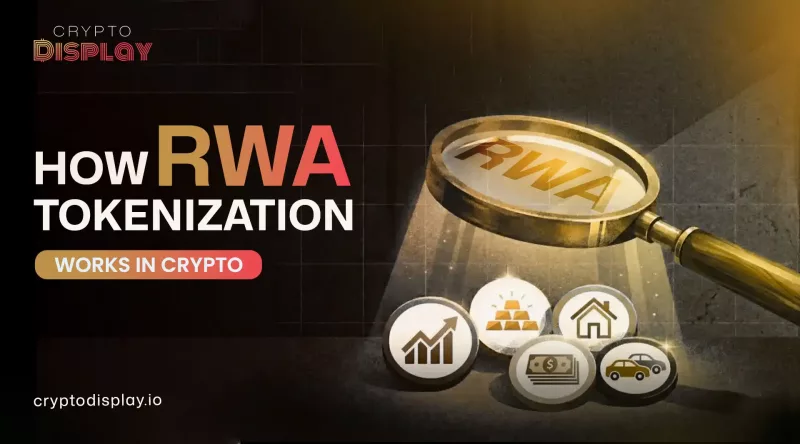
RWA means Real-World Asset. These are things that exist in the real world- like houses, gold, farmland, or government bonds. RWA Tokenization means turning ownership of those things into digital tokens on a blockchain.
A token is like a digital receipt. It proves you own a small piece of something real. You can buy it, sell it, or hold it all from your phone, from anywhere in the world.
Many investors are now exploring real world asset crypto projects that bring traditional investments like property, bonds, and commodities onto blockchain networks.
Why Do People Care About This?
For a long time, big investments were only for rich people. A normal person could not buy part of a skyscraper or invest in a private loan fund. The barriers were too high.
RWA tokenization changes that. It breaks expensive assets into tiny affordable pieces. It removes slow middlemen like banks and brokers. And it lets people from any country invest in things that were never open to them before.
It also makes assets easier to trade. Normally, selling a building takes months. With tokenization, you can sell your digital piece in minutes on a blockchain marketplace.
To understand the broader impact of this technology, it helps to explore how RWA tokenization could change traditional finance and open global investment markets.
How Does It Actually Work? (Step-by-step)
The process is simpler than it sounds. Here are the three main steps.
Step 1-Verify the Real Asset.
Before anything goes on a blockchain, someone must prove the asset is real and legally owned. A certified evaluator checks the value. Lawyers confirm ownership. The asset is then placed inside a legal structure called a 'Special Purpose Vehicle' (SPV).
Think of the SPV like a secure box. The real asset goes inside the box. The box is then connected to the block-chain. This legal step protects investors and makes sure no one can fake ownership.
Step 2 Connect the Asset to the Blockchain.
Once the asset is verified, its details value, location, ownership, legal status must be sent to the blockchain. This is done through a tool called a blockchain oracle.
An oracle is like a trusted messenger. It takes real-world information and delivers it on-chain so the system always has accurate data. If the value of a property goes up, the oracle updates that number on the blockchain automatically.
Step 3 Create and Issue the Tokens.
A smart contract then creates the tokens. A smart contract is just a piece of code that runs on the blockchain. It follows rules automatically - no human needed in the middle.
Once the tokens are created, they are issued to investors. Each token represents a share of the real asset. Token holders can receive income from the asset- like rent payments - directly through the smart contract, without any bank involved.
What Assets Can Be Tokenized?
Almost anything with real value can be tokenized. Here is a simple table showing the most common types:
|
Asset Type. |
Real-World Example |
Why People Tokenize It |
|
Real Estate |
Office buildings, homes |
Fractional ownership, faster sales |
|
Government Bonds |
U.S. Treasury bills |
Stable returns, global access |
|
Gold |
Physical gold bars |
Easy to trade, no storage needed. |
|
Private Credit. |
Business loans. |
Higher returns, previously closed off |
|
Art & Collectibles |
Paintings, rare items |
Access to luxury investment class |
A Real Example- Gold Tokens
One of the easiest examples to understand is tokenised gold. Companies like Paxos issue tokens called PAXG. Each token equals one troy ounce of real gold stored in a vault.
You do not need to store heavy gold bars at home. You just buy a token. You can sell it at any time, send it to anyone, and use it in cryptocurrency applications. The gold is real and kept in a secure vault, and your token proves you own a portion of it.
This is RWA tokenization in its simplest form.
Why Blockchain Is Used
Blockchain plays a key role in RWA tokenization. It keeps a shared record of all token transactions. No single company controls this record. Every new transaction is added to the blockchain, creating a clear history over time.
As the ledger is shared by multiple computers, updating previous records is extremely difficult. This structure promotes trust in ownership data.
Many analysts believe RWA tokenization is only one part of broader blockchain technology trends shaping the future of digital finance.
How Big Is This Market?
The RWA market has grown fast. Just a few years ago, it barely existed. Today, it holds tens of billions of dollars in tokenized assets- including bonds, credit, real estate, and commodities.
Major financial companies like BlackRock, Franklin Templeton, and JP Morgan have all launched tokenized products. BlackRock's tokenized money market fund crossed $1 billion in its first year. That shows this is not just a small crypto experiment. It is becoming a serious part of global finance.
Analysts believe the market could grow into the trillions of dollars over the next decade as more assets move onto blockchain rails.
What Are the Risks?
RWA tokenization is exciting, but it comes with real risks. Buyers should know these before investing.
Legal gaps- Laws around digital ownership are still being written. What happens in a dispute can be unclear, especially across different countries.
Smart contract bugs- Code is written by humans. Mistakes in smart contracts can lead to lost funds, and those losses are often impossible to reverse on a blockchain.
Low liquidity- Just because an asset is tokenized does not mean it is easy to sell. If few people want to buy your token, you may be stuck holding it.
Custodian risk- Someone still has to store the real-world asset safely. If the company holding the gold or property fails, token holders could face serious problems.
The Simple Summary
RWA tokenization takes real things buildings, gold, bonds, art - and turns ownership into digital tokens on a blockchain. It breaks big expensive assets into small affordable pieces. It lets anyone in the world invest, not just wealthy insiders. And it makes buying and selling faster, cheaper, and more transparent.
The technology is still young. Regulations are still catching up. But the direction is clear. The wall between traditional finance and crypto is coming down- one token at a time.
Whether you are an investor, a curious reader, or someone building in the space, understanding RWA tokenization gives you a head start in what could be one of the biggest financial shifts of our lifetime.
This article is for educational purposes only. It is not financial advice. Always research before making any investment.