
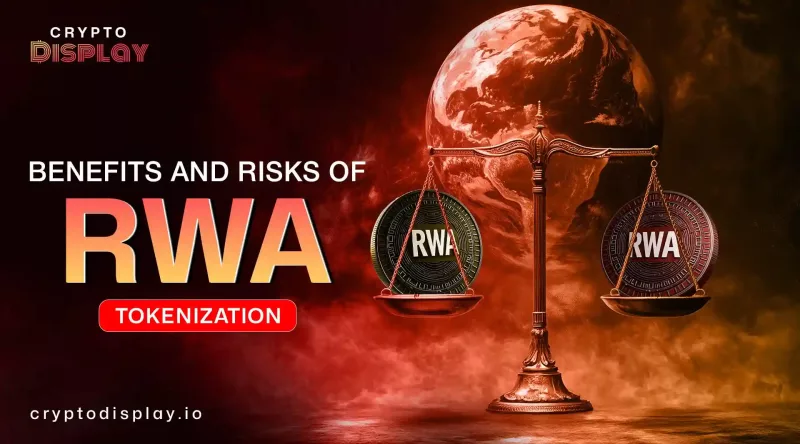
Learn Real Benefits and Hidden Risks of RWA Tokenization
RWA Tokenization: Opportunities and Risks Investors Must Know
Real-world asset tokenization is changing how people invest. Big banks are doing it. Crypto projects are building around it. Everyday investors are asking about it.
But is it actually a smart move- or a dangerous one?
The honest answer is both. RWA tokenization carries real benefits that open up investing to everyone. It also carries real risks that can hurt you badly if you jump in without understanding what you are getting into.
This article covers both sides simply and honestly. No hype. No scare tactics. Just clear facts. If you want to understand the technology behind it first, you can explore our guide on how RWA tokenization works before diving into the benefits and risks.
What Is an RWA Token?
An RWA token is a digital token on a blockchain that represents ownership of something real- a building, gold, a government bond, farmland, or a private loan.
Think of it like a digital receipt. That receipt proves you own a small piece of something that actually exists in the physical world. You can buy it, sell it, or hold it from a crypto wallet, from anywhere on earth.
The RWA tokenization market reached $24 billion in 2025, growing 308% over three years, with projections suggesting it could reach $30 trillion by 2034.
That kind of growth makes understanding both the upside and the downside genuinely important for every investor.
Many investors are already researching the top RWA tokens in the crypto market to understand which projects are building around this fast-growing sector.
The Benefits of RWA Tokenization
1. Anyone Can Invest - Not Just the Wealthy
This is the biggest change RWA tokenization brings to the table.
Before blockchain, buying into a commercial building or private equity fund required hundreds of thousands of dollars and the right connections. Regular people were locked out completely.
RWA Tokenization allows real-world assets to be divided into fractional interests, enabling ordinary investors to own a portion of a high-value asset they could never afford to purchase outright.
A teacher with $500 can now own a piece of a commercial building. A student can hold tokenized government bonds. The high barriers that kept regular people out for decades are finally starting to come down.
Because of this new access, many investors are also looking at active RWA crypto presales where early blockchain projects are building tokenized asset platforms.
2. Assets Become Easier to Buy and Sell
Real estate and private equity are traditionally illiquid. Selling them takes months and costs thousands in fees.
RWA tokens allow 24/7 trading -buying and selling is no longer limited to traditional market hours or expensive intermediaries. These digital assets are available to people across the globe, including those without access to conventional banking.
A token tied to a rental property can be sold in minutes on a blockchain marketplace. No agent fees. No months of waiting. No mountain of paperwork.
3. Passive Income Goes Straight to Your Wallet
Many RWA tokens automatically pay out income to holders through smart contracts. No bank delay. No middleman taking a share.
RWA tokens deliver steady income from rent, dividends, and bond coupons - blending the speed of DeFi with the real-world value of traditional finance.
Your share of monthly rental income lands in your wallet automatically. That kind of hands-free income was previously only available to wealthy property owners.
4. Faster Settlements and Lower Costs
Traditional markets settle trades in two full business days. That gap ties up capital that could be working elsewhere.
Tokenized assets settle in near real-time, reducing counterparty risk and freeing up capital that would otherwise sit locked in slow settlement processes.
Smart contracts also cut out brokers, clearing houses, and notaries. Both buyers and sellers save real money on every single trade.
5. Full Transparency on Every Transaction
Every ownership transfer on a blockchain is recorded permanently. Nobody can secretly change the records.
Public blockchains offer a shared, immutable ledger, every movement of an asset token creates a clear and auditable trail that proves ownership across time.
For anyone burned by hidden fees or shady financial products before this openness is a meaningful upgrade.
Benefits at a Glance.
|
Benefit |
What It Means for You |
|
Fractional Ownership |
Buy small pieces of expensive assets |
|
24/7 Trading |
Buy or sell any time - no market hours |
|
Passive Income |
Earn rent and dividends automatically |
|
Faster Settlement |
Near real-time vs. 2-day traditional wait |
|
Full Transparency |
Every transaction permanently recorded |
|
Lower Costs |
Smart contracts replace expensive middlemen |
The Risks of RWA Tokenization
Now for the part that matters just as much. The risks are real and serious.
Risk 1- Legal Uncertainty
Questions of title, enforceability of smart contracts, and cross-border recognition remain unresolved- even as regulators from the FCA, ESMA, and the SEC signal openness to experimentation.
If something goes legally wrong, courts in most countries still do not know how to handle RWA token disputes. Ownership rights that feel solid on a blockchain may not hold up in court. The laws protecting token holders are still being written.
Risk 2 - Smart Contract Bugs
Code is written by humans. Humans make mistakes.
Smart contract vulnerabilities, cyber risks, and insecure key management are genuine technical risks - and unlike traditional banking systems, blockchain transactions are often completely irreversible.
If a bug is exploited, your money could disappear permanently. There is no customer service line to call and no bank to reverse the charge.
Risk 3 - Low Liquidity After Launch
Putting an asset on a blockchain does not automatically create a crowd of buyers.
Despite over $25 billion in tokenized RWAs on-chain, most tokenized assets still show low trading volumes, long holding periods, and limited secondary-market activity.
If few buyers exist for your token on a given day, you are simply stuck holding it. Liquidity is built slowly over time - never guaranteed.
Risk 4 - The Asset Behind the Token Can Lose Value
A token is just a wrapper around a real asset. It does not protect that asset from falling in price.
Tokenization improves how assets are distributed and recorded -but it cannot change the economic fundamentals of the asset itself. If demand or value drops, the digital wrapper does nothing to change that outcome.
If the building behind your token falls in value, your token falls with it. Blockchain does not change basic economics.
Risk 5 - Custodian Failure
Someone in the physical world must hold the real asset. A company stores the gold. A legal entity holds property deeds. You are trusting those people completely.
If the custodian acts dishonestly, faces insolvency, or fails their legal obligations, token holders may find it very difficult to recover their investment - especially across different legal jurisdictions.
The blockchain can be perfectly clean. But if the real-world side fails, everything falls apart with it.
Benefits vs Risks - Side by Side
|
Area |
The Benefit |
The Risk |
|
Access |
Fractional ownership for everyone |
Legal ownership unclear in disputes |
|
Trading |
24/7 global marketplace |
Low liquidity on many tokens |
|
Technology |
Automated smart contracts |
Code bugs cause irreversible losses |
|
Transparency |
Permanent on-chain records |
Off-chain custodian fraud still possible |
|
Returns |
Passive income from real assets |
Underlying asset can still lose value |
|
Regulation |
Growing clarity in EU and US |
No clear rules in most countries yet. |
The Bottom Line
RWA tokenization does not remove risk from investing. It changes the shape of it.
The benefits are real - fractional ownership, passive income, 24/7 trading, lower costs, and full transparency. But the risks are equally real -legal gaps, smart contract bugs, low liquidity and custodian failure.
Major institutions including BlackRock, Franklin Templeton, and JPMorgan have already moved into this space - a strong signal that the infrastructure is maturing and the direction of travel is set.
But early stages of any financial shift carry the most risk for everyday investors. Learn everything before you move. Start small. And never put in money you are not fully prepared to lose.
Disclaimer
This article is for educational purposes only. It is not financial advice. Always do your own research before making any investment decision.

Frequently Asked Questions
 Explore Our FAQs
Find quick answers to commonly asked questions and understand how things work around here.